Running is a sport with many advantages. First of all, it does great things for your health: it keeps the heart in shape, it burns fat fast and it sculpts the muscles in an effective way. But running has a positive influence on your mind also; when you run you have fun, you socialize easier, you reduce stress and you feel good about yourself.
Running on the treadmill is a training option which comes in handy, especially for those with a busy schedule. While treadmill running certainly has its pros and cons compared to running outdoors, it remains one of the easiest and most effective ways to stay active year-round. For those with knee issues, the treadmill surface can certainly be a lot less taxing than an outdoor run, especially if you’re used to running on uneven, hilly terrain.
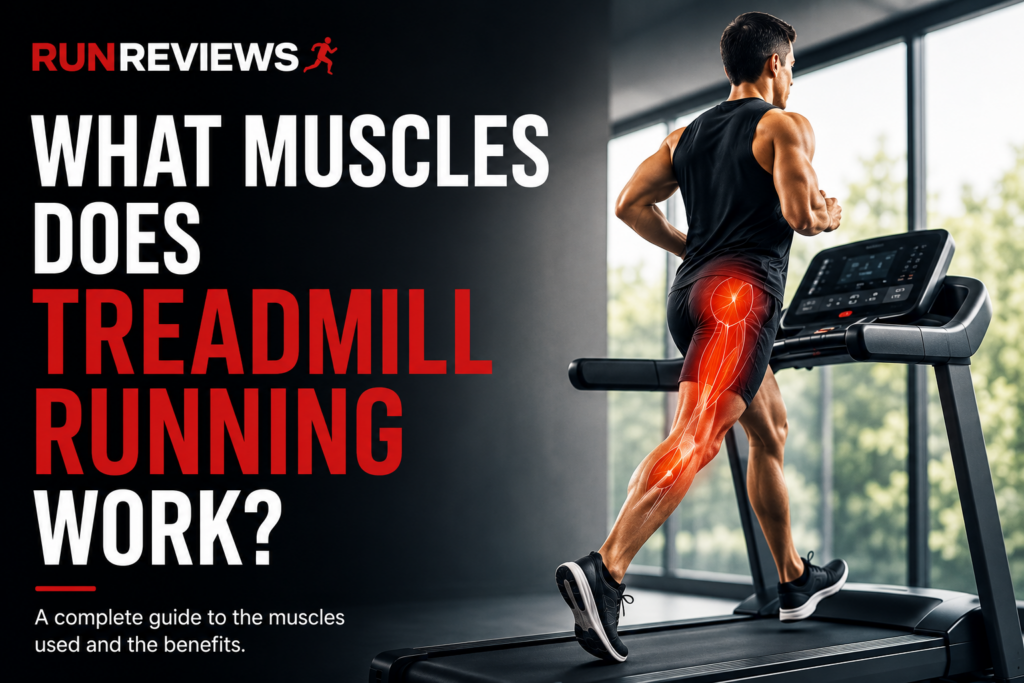
Even if you muscle building isn’t one of your main fitness goals, running on the treadmill still has a tremendous effect on several important muscle groups.
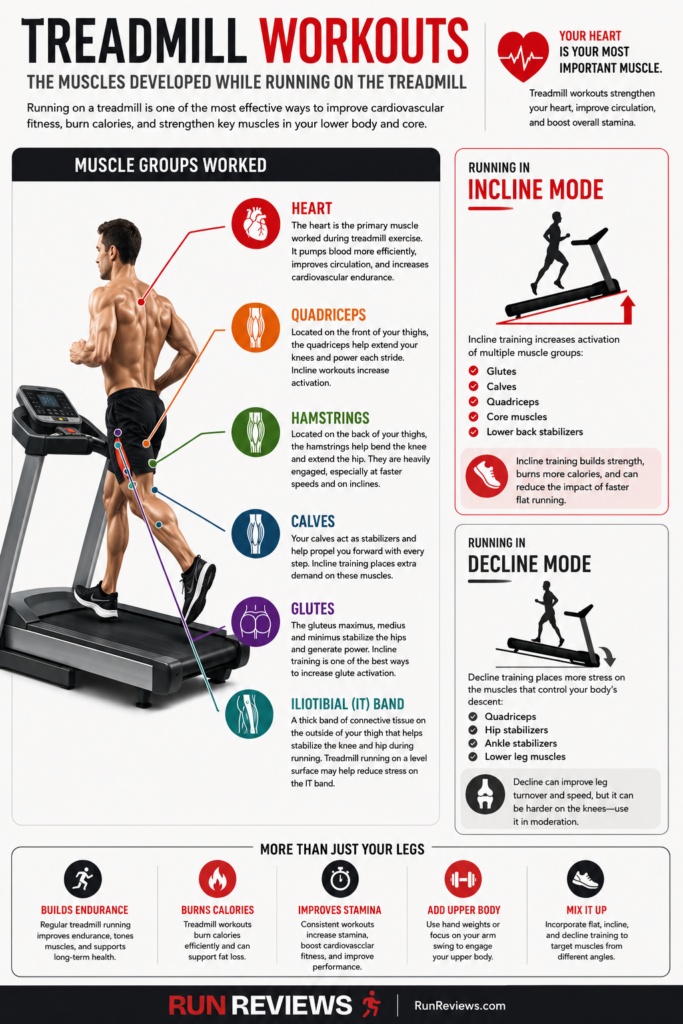
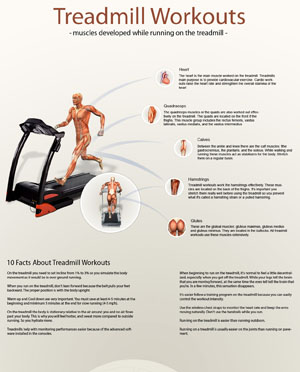
Muscle Groups Developed While Running On The Treadmill
The Heart
The heart is the primary muscle you train while exercising on a treadmill.
Treadmills provide excellent cardiovascular exercise that raises your heart rate and improves overall cardiovascular endurance. Over time, regular treadmill workouts can strengthen the heart, improve circulation and increase stamina.
This is one of the reasons treadmills remain one of my favorite pieces of home fitness equipment. Even a simple walking routine can provide significant health benefits, and although I enjoy the outdoor scenery, sometimes you just can’t get outside for one reason or another.
Quadriceps
The quadriceps are located on the front of the thighs and play a major role in both walking and running.
Every step on the treadmill engages the quads as they help extend the knee and propel you forward. Incline workouts tend to place even greater emphasis on these muscles.
Calves
The calf muscles are located between the ankle and the knee and serve as important stabilizers during treadmill exercise.
Whether you are walking or running, the calves are constantly working to absorb impact and help push the body forward. This is one reason many people notice calf soreness when first starting a treadmill program or adding incline workouts.
Because of their constant use, regular stretching of the calves is important. Simple stretches are fine, or if you can find one of those platform devices where you can vary the angle, those can give you an even deeper stretch.
Hamstrings
The hamstrings are located on the back of the thighs and assist with bending the knee and extending the hip.
Treadmill workouts help tone and strengthen these muscles, particularly during faster running speeds and incline sessions.
Hamstrings are also one of the more commonly strained muscle groups among runners, so a proper warm-up before your workout is important.
Glutes
The gluteal muscles consist of three muscles: Gluteus maximus, Gluteus medius and Gluteus minimus. These muscles help stabilize the hips and generate power while running.
In my experience, many treadmill users underestimate how much their glutes are being activated, particularly during incline training. Even a modest incline can make a noticeable difference.
Iliotibial (IT) Band
The iliotibial (IT) band is a thick band of connective tissue located on the outside of the thigh.
While it is not technically a muscle, it plays an important role in stabilizing the knee and hip during running.
Some runners find that treadmill running can actually be easier on the IT band because the running surface is level and predictable compared to uneven outdoor terrain.
Muscles Used When Running in Incline Mode
One of the biggest advantages of treadmill training is the ability to easily add incline.
Incline training increases activation of several muscle groups, including:
- Glutes
- Calves
- Quadriceps
- Core stabilizers
- Lower back muscles
One thing I have personally noticed over the years is that even a relatively small incline can make a workout feel significantly more challenging while reducing the need to run at very high speeds.
Incline training is also popular because it can help reduce some of the repetitive heel striking associated with flat running.
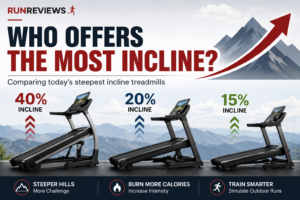
There are a lot of great incline treadmill options out there today. NordicTrack offers the most with 40% on their X Series treadmills, but you can find at least 15% on other NordicTrack machines, as well as those from Sole and Horizon.
Muscles Used When Running in Decline Mode
Decline running requires less cardiovascular effort than incline running, but it places greater stress on the muscles responsible for controlling your body’s descent.
This includes many of the “anti-gravity” muscles in the:
- Hips
- Quadriceps
- Ankles
- Lower legs
Decline training can also improve leg turnover and may help runners prepare for races that include downhill sections.
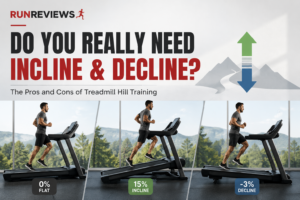
However, keep in mind that running on a decline treadmill can be extremely hard on knee joints.
Does Running on a Treadmill Build Muscle?
Treadmill workouts are not a substitute for strength training, but they can absolutely improve muscular endurance and tone.
Many people notice improvements in:
- Leg definition
- Calf strength
- Glute activation
- Overall lower-body endurance
Incorporating flat, incline and decline workouts (if your treadmill offers all three) can help target muscles slightly differently and keep your workouts from becoming repetitive.
And if you really want to add an extra challenge, picking up a light set of dumbbells while walking can also engage the upper body and complement the natural arm swing that occurs during treadmill exercise.
One of the biggest benefits for me that I’ve noticed is strengthening the muscles around the knee. I was getting a lot of knee pain playing pickleball and although I thought that running might exacerbate the situation, it actually helped stabilize it and I’ve been able to play without a knee brae for quite some time. Let’s hope that lasts!